Referral code and fee discount: what changes, and what doesn't
Plainly: a code returns part of the fee you were going to hand over anyway. It is not a bonus the platform adds on top. Once that is clear, "sign up and get 20%" stops sounding like free money and starts sounding like what it is — and you can work out for yourself what it's worth in your case.
Registering with our code can earn you up to 20% off trading fees*
* The actual rate is whatever Binance displays at the time and can change with their programme. This block contains a referral link and we may earn a commission from it; using our code does not make you pay more. POOLROW is not the official Binance website and has no affiliation or agency relationship with Binance — see our disclosure.
Where the money comes from
Every trade you make on an exchange pays a fee. The exchange keeps it. Under a referral programme, a slice of that fee is shared: some goes back to you as a discount, some goes to whoever referred you. Nothing is created and nothing extra is charged — a pot that used to go entirely to the platform is divided three ways instead of one.
That is why "does this cost me more?" has a straightforward answer of no, and why we can say it without hedging. Your fee with a code is the same as or lower than your fee without one. Our commission comes out of the platform's share, not out of yours.
It is also why we would rather explain the mechanism than shout a number at you. A site that leads with "sign up and get 20%" is describing a rebate on your own spending as though it were a gift. If a page never tells you where the money comes from, that omission is doing work.
A code slightly reduces a cost you were going to pay. It does not add income and it does not change what you are eligible for. Worth two minutes at sign-up. Not worth reorganising anything else around.
Understanding the fee itself
Before a discount means anything, the thing being discounted has to be legible. Spot trading fees are usually quoted as a percentage of order value, with a lower rate for orders that add liquidity to the book and a higher one for orders that take it. Higher trading volume and holding the platform token move you down the tiers.
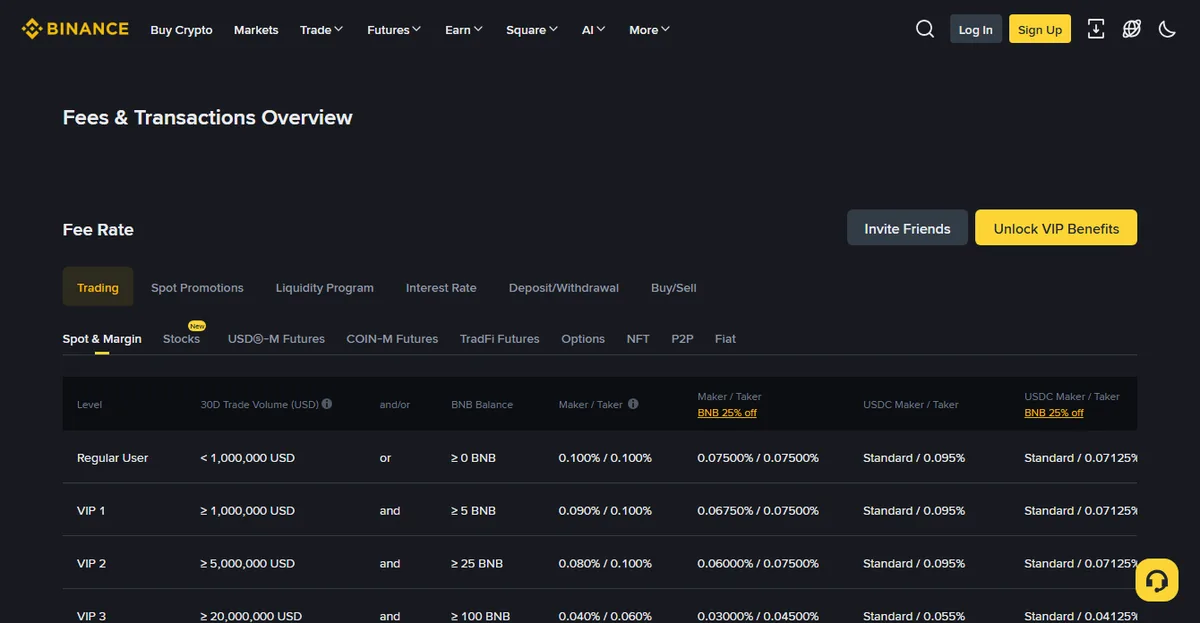
A referral discount is applied to that rate rather than replacing it. So the saving scales with how much you trade, and for someone who makes four trades a year it rounds to nothing. The live numbers are on the Binance fee schedule; that page is the authority, not this one.
One more distinction that saves confusion later: trading fees are not the same as network withdrawal fees. The first is the exchange's charge and is what a code touches. The second is the cost of moving assets on a blockchain, it varies with the network you pick, and no referral code has ever reduced it.
When it has to be entered
At registration. That is the whole of the answer, and it is the reason this page exists at all rather than being a footnote somewhere.
The relationship is written when the account is created. Afterwards, support will generally decline to attach a code, and there is no setting for it. People discover this the way you would expect — a month in, having read something about fee tiers, wondering whether it can be added retroactively. It cannot.
There are two ways to enter it and they are the same mechanism. Either you arrive through a link that carries the code as a parameter and the field is filled for you, or you open the "referral code (optional)" field on the registration form and type it. They do not stack. Using a link and then also typing the code is not more reliable; it is the same single value arriving by a different route.
If you clicked someone else's referral link earlier in the same browser, that parameter may still be held in your session and can override what you type later. Which one ends up bound is not predictable. Register in a fresh window, or clear the site data first — and then check the account afterwards, because nothing on screen will flag the conflict.
Who it is worth something to
The value depends entirely on how much you trade, and the range is wide enough that a single recommendation would be dishonest.
| How you use the account | Roughly what a discount is worth |
|---|---|
| Stake BNB in Launchpool, nothing else | Near zero — staking involves no trading |
| Hold BNB in Earn for HODLer snapshots | Near zero, for the same reason |
| Buy occasionally, hold long term | Small — a few trades a year is a few fees a year |
| Work Alpha Points daily | The real case — fees are the dominant cost there |
| Trade actively across pairs | Meaningful, and compounding with volume |
The Alpha Points row is the one worth dwelling on. Volume points are earned by buying, every buy pays a fee, and a serious points routine means trading every day in a section where spreads are already wider than main spot pairs. Trimming the fee side by a fifth changes the arithmetic in what points really cost in the direction you want — modestly, but every single day.
For the first two rows, be sceptical of anyone who tells you otherwise. Staking BNB in a pool involves no trades, so there is no fee for a discount to apply to. If a site is pushing a code at Launchpool participants on the strength of a fee discount, it is either not thinking or hoping you won't.
Three things it does not affect
- Launch eligibility. Launchpool splits each hour's emission by stake share. HODLer looks at BNB in eligible Earn products across a snapshot window. Alpha Points count balance tier and purchase volume. No referral term appears anywhere in these.
- Allocation size. Nobody receives a larger share for having registered through anybody. The formulas are published and they are arithmetic.
- Regional availability. If a product is not offered where you live, no code changes that. See what regional restrictions actually block.
We are spelling this out because the opposite claim is common. "Register with my code for a better airdrop allocation" is false on the published rules, and a site willing to say it will be willing to say other things too.
Confirming the code actually attached
Two minutes, once, right after registering.
- Open the referral or rewards area of your account.
- Look for who invited you, or the code the account is bound to.
- If it is displayed, it took. If nothing is displayed, it did not — and there is no fix after the fact.
- Check your fee rate on the account's fee page and compare it against the published standard rate for your tier.
Step four is worth doing even if step three looked fine, because a bound relationship and an applied discount are two different states and the second is the one you care about. The full registration walkthrough, including where each screen puts things, is in opening an account and attaching the code.
Rates, tiers and referral programme terms are set by Binance and change without notice. Figures on this page are indicative and were checked in August 2026. What the platform shows you at the moment you register is what applies.
Questions people ask
Does using your code cost me anything?
No. Your fee is the same or lower than it would be without a code. Part of what the platform collects is shared with the referrer, so our commission comes out of the platform's share rather than being added to your bill.
Can I enter a code after registering?
Normally no — the relationship is fixed at account creation. If you registered without one, you have lost a fee discount and nothing else. No launch eligibility depends on it.
Is 20% guaranteed?
No. Whatever Binance displays when you register is what applies, and referral programmes change. Treat any figure quoted on a third-party site, ours included, as an indication rather than a promise.
Does the code help me get into Launchpool or an airdrop?
No, and anyone implying otherwise is misleading you. Launchpool pays by stake share, HODLer by BNB held in eligible Earn products during the snapshot window, Alpha Points by balance and purchase volume. None of those calculations include a referral term.