Opening a Binance account and attaching the referral code
Almost every message we get that starts with "I missed it" ends in one of three places: the account was never verified, the deposit hadn't cleared, or the person was still reading the rules when the window shut. None of those are hard problems. They're just problems you can't solve on the morning itself.
An account. A completed verification. A referral code entered at sign-up. The first two decide whether any of the four launch lines will let you in at all. The third decides what your trading costs afterwards — it has no effect on eligibility, which is worth knowing before you spend an evening worrying about it.
Whether you can use it where you live
Start here, because everything downstream depends on it and it takes two minutes. Binance does not operate identically everywhere. Some countries are not served at all. Some are served through a separately licensed local entity where the product menu is noticeably shorter than the global one. And some products — futures, margin, certain Earn categories — are switched off for particular jurisdictions even where the exchange itself is available.
This matters more for launches than for ordinary trading, because the four lines lean on different products. HODLer Airdrops require your BNB to be sitting in Simple Earn or On-Chain Yields. If Earn is unavailable in your country, that line is closed to you no matter how much BNB you hold. Launchpool is generally the most widely available of the four. Alpha Points and the token generation events attached to them run through the Alpha section and the Web3 wallet, which have their own regional availability.
So the practical sequence is: work out which entity serves your residence, then look at which of the four lines that entity actually offers, and only then decide whether the account is worth opening for your purposes. Doing it the other way round — open the account, fund it, then discover the product you wanted is greyed out — is a fairly common way to waste a week. We wrote up the geography side separately in what regional restrictions actually block.
A blunt version of the check: if you can't find Simple Earn in the app under your own login, HODLer Airdrops are not a line you can play. Don't argue with it and don't look for a workaround — using tools to misrepresent where you are is how accounts get frozen with funds inside them.
The sign-up screen wants one thing
People build this step up in their heads. The reality is one input field.
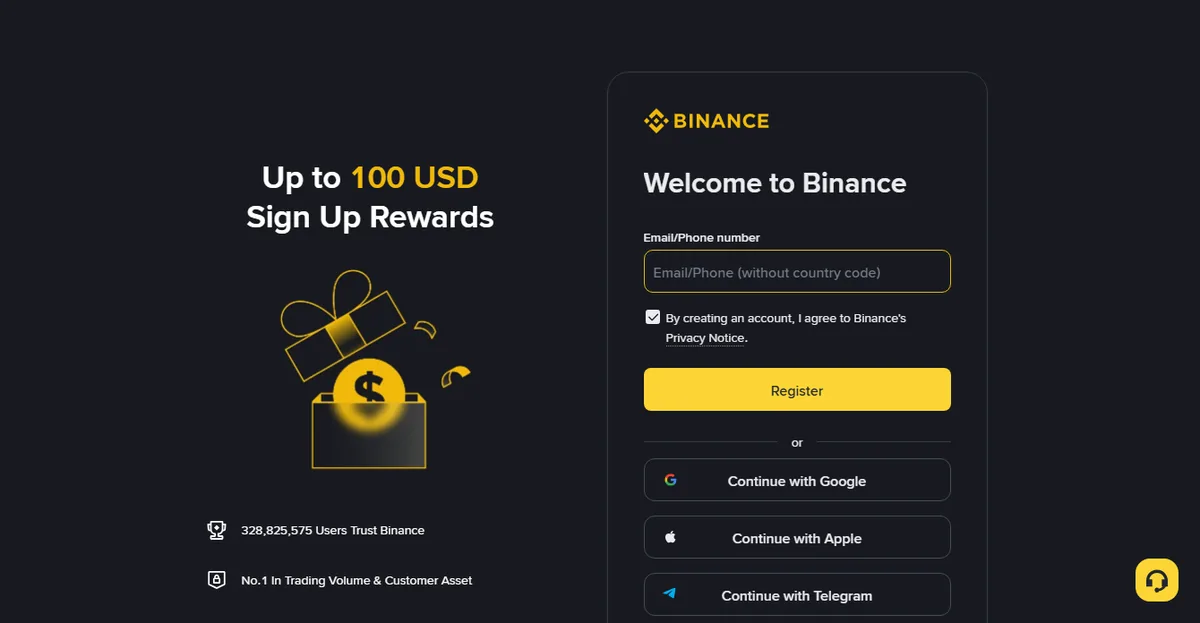
The left-hand column is promotional and rotates with whatever is being pushed that month. The right-hand column is the part you interact with. Below the field sits the consent checkbox for the terms and privacy notice, usually pre-ticked, and under that a row of "continue with Google / Apple / Telegram" buttons.
Signing up through a third-party account is genuinely quicker, and I still don't use it. The reason is unglamorous: if that third-party account is ever compromised, disabled or unlinked, your route into the exchange account inherits the problem. Registering with an email address keeps the login entirely in your own hands, and the ten seconds you save are not worth the coupling.
Email or phone number is the other small decision hiding on that screen, and it is worth thirty seconds of thought. A phone number ties your login to a SIM you might change, port, or lose access to while travelling; recovering an account when the number has gone is slower and involves more identity checks than recovering one tied to an email address you still control. Use an address you will still have in three years, ideally one that is not shared with anything else, and put its own two-factor on it — the mailbox behind an exchange account is a target in its own right.
Whichever route you take, after registering go and confirm the referral relationship inside the account. There is normally a referral or rewards page showing who invited you, or the code your account is bound to. If it's showing, it took. If it isn't, it didn't — and nothing on the sign-up screen will have told you either way.
Where the code goes and when
The code field is not on the first screen. Depending on which flow you land in, it appears either at the bottom of the second step behind a small "referral code (optional)" toggle, or it is filled in for you automatically because you arrived through a link that carried it.
Those two are the same mechanism. A referral link is a normal URL with the code attached as a parameter; the browser fills the field so you don't have to. That's the whole difference. They don't stack, and there is no such thing as "using the link and then typing the code as well, to be safe".
Registering with our code can earn you up to 20% off trading fees*
* The actual rate is whatever Binance displays at the time and can change with their programme. This block contains a referral link and we may earn a commission from it; using our code does not make you pay more. POOLROW is not the official Binance website and has no affiliation or agency relationship with Binance — see our disclosure.
One trap worth naming, because nobody warns you about it: if you clicked somebody else's referral link earlier in the same browser, that parameter may still be sitting in your session. Type a different code later and which one ends up bound is not something you can predict. The clean approach is a fresh browser window, or clearing site data, and then walking the flow from the beginning. Nothing on screen flags a conflict, and nobody tells you afterwards, which is exactly why that post-registration check earns its place.
And to state the obvious once: a code can only be attached while the account is being created. After the fact, support will generally decline to add one. If it matters to you, deal with it in the two minutes it takes rather than planning to fix it later.
What the code actually changes
A referral code adjusts trading fees. That is the whole of it. It does not touch your Launchpool allocation, it does not affect whether a HODLer snapshot counts you, and it does not add Alpha Points. Launchpool splits each hour's emission by stake share; HODLer looks at BNB sitting in eligible Earn products across the snapshot window; Alpha Points count balance tiers and purchase volume. None of those calculations contain a referral term.
Where it does earn its keep is Alpha Points, and the reason is specific. Volume points are earned by buying, and every buy pays a fee. Someone chasing a meaningful daily score is trading repeatedly, often in the Alpha section where spreads are already wider than on main spot pairs. Trim the fee side by a fifth and the arithmetic on what points really cost moves noticeably — not dramatically, but in the direction you want, every single day you keep it up.
For a Launchpool-only participant the code is close to irrelevant, because staking BNB in a pool involves no trading at all. Being clear about that is more useful to you than overselling it: the discount is worth having, it is not a reason to change your strategy, and anybody presenting it as the main event is selling you something. The current published fee tiers live on the Binance fee schedule, and that page is the authority on the number, not us.
A worked example, so the number means something
Percentages off percentages are hard to feel. Put rough figures on it instead. Say you are working an Alpha Points routine and buying around 400 US dollars of tokens a day to keep your volume score where you want it. Over a fifteen-day scoring cycle that is roughly 6,000 dollars of purchases. At a nominal 0.1% taker fee you have paid about six dollars in fees across the cycle. Shave a fifth off and you keep somewhere near 1.20 dollars.
Which sounds like nothing, and it is nothing — for one cycle. Run the same routine continuously for a year and the same arithmetic lands closer to thirty dollars, against roughly a hundred and fifty spent. Whether that matters depends entirely on what the points earned you, and that is the calculation people skip. A discount on a losing activity is still a loss.
The honest framing: the code is a small permanent reduction to a cost you were going to pay anyway. It doesn't rescue a bad plan and it doesn't create an opportunity. It is worth the two minutes at sign-up and worth exactly nothing more than that, which is why we would rather you read the real cost piece before you read another word about discounts.
Verification is the real gate
An account without completed identity verification is a viewing seat. You can look at the interface, browse markets and read the announcements. You generally cannot deposit, trade, or take part in any campaign — and every one of the four lines is a campaign.
The process itself is short: personal details, a photograph of a government-issued document, and a liveness check where you turn your head in front of the camera. When the automated pass is satisfied it can be over in minutes. When it isn't, the submission goes to a human queue and the wait becomes a day, sometimes several.
The failure mode is not the difficulty, it's the timing. Verification is the only step in this whole sequence whose duration is not under your control, and people reliably attempt it on the day they want to do something. Do it in a quiet moment instead. Good light, a document that is not expired, a name spelled exactly as printed, and a phone camera rather than a scan of a photocopy will handle most of it. When it goes wrong repeatedly, the specific fixes are in when verification will not go through.
Do not verify with someone else's documents and do not run several accounts on one identity. Both are grounds for suspension, and the moment it happens is generally the moment there is a balance inside worth suspending. The rules on this are not negotiated case by case.
Three settings to make straight away
These take under ten minutes combined and they are much easier to do now than during a scramble.
- Two-factor authentication that isn't SMS. An authenticator app or a hardware key. SMS is better than nothing and worse than either, because the number itself can be taken from you.
- The withdrawal address whitelist. Turning it on restricts withdrawals to addresses you have pre-approved. There is a waiting period when you enable it or add an address, which is the entire point — and also the reason to do it before you have anything urgent to move.
- API keys: leave them alone. If you are not running a bot you have no reason to create one. If you already have keys you no longer use, delete them rather than leaving them idle.
The order matters more than it looks. Enable the whitelist before your first deposit, not after, so the cooling-off period expires during a week when you don't need it. Do it the other way round and you will find yourself waiting out a timer while watching a price move. The longer version of all three, including how to migrate them when you change phones, is in account security.
From account created to actually eligible
An account that exists is not an account that can take part. Between the two sit a few steps whose duration nobody mentions in the sign-up flow.
| Step | Typical wait | Blocks which lines |
|---|---|---|
| Identity verification | Minutes to several days | All four |
| Deposit clearing (on-chain) | Minutes to an hour | All four |
| Deposit clearing (card or bank) | Hours to days, plus a hold | All four |
| Moving BNB into Simple Earn | Immediate, but snapshots watch duration | HODLer Airdrops |
| Creating and backing up the Web3 wallet | Ten minutes, done once | Megadrop, Alpha TGE |
The row people underestimate is the last one. Megadrop's published rules require a Binance Web3 Wallet that has been created and backed up; an account without one does not qualify however many quests it completes. It is a ten-minute job that people leave until the quest list is already open, and writing down a seed phrase properly is not something to rush. What that wallet is and how it differs from your exchange balance is covered in the wallet piece.
The BNB row deserves a note too. Simple Earn subscriptions are instant, but HODLer snapshots sample your balance repeatedly across a window rather than taking one reading. Depositing on the last day of a window gets you a fraction of the average someone else built over the full period. Early is worth more than large, within reason.
A sensible order for the first week
If you have no particular deadline, this ordering removes most of the ways the first week goes wrong.
- Day one. Register, enter the code, confirm the referral relationship shows up in the account. Submit verification the same evening so any queue time runs overnight.
- Day two. Set up authenticator-based two-factor. Enable the withdrawal whitelist while you have nothing to withdraw, so its waiting period elapses harmlessly.
- Day three. Make a small test deposit — an amount you would shrug at losing. Watch it arrive. Learn what the confirmation timings feel like on the network you chose.
- Day four. Create the Web3 wallet and back up the recovery phrase on paper, offline. Confirm the backup by restoring it somewhere you can afford to get wrong.
- Day five. Read the rules of one line only, and pick it. Trying to run all four in your first week is how people end up doing all four badly.
- Day six or seven. Take part in something small. The goal is not profit, it's finding out which step in your own setup is slower than you assumed.
Nothing in that list is urgent, which is precisely why it works. Every item on it becomes urgent the moment an interesting pool opens, and none of them can be compressed at that point.
Where people get stuck
Roughly in order of how often we're asked about them:
- "The verification code email never arrives." Check spam, then check whether you typed the address correctly, then wait — resending five times in a minute triggers rate limiting and makes it slower.
- "My country isn't in the list." That is an answer, not an obstacle. Do not attempt to work around it.
- "Verification failed and won't say why." Almost always the document photo — glare, a cropped corner, or an expiry date that has passed. Retake it in daylight against a plain surface.
- "The referral code field never appeared." You are in a flow that expected the parameter from a link. Start again from the link, or from a clean window with the code ready.
- "I registered without a code." Then it's done. Adding one afterwards is not normally possible, and you have lost a fee discount rather than any eligibility.
- "My deposit hasn't arrived." Compare the network you sent on with the network the deposit address was issued for. If they differ, stop and read the recovery process rather than sending more.
- "I can't see Simple Earn." Product availability by jurisdiction. Nothing you can change in settings.
- "Two-factor stopped working after I changed phones." The authenticator seed did not move with the SIM. This is the situation the whitelist and the backup codes exist for.
- "I completed the quests but got nothing." Check whether the wallet was created and backed up before the deadline. That prerequisite catches a lot of people.
Something all nine share: each is cheap to prevent and expensive to fix under time pressure. That asymmetry is the actual argument for doing this whole sequence on an ordinary Tuesday rather than on the morning of something you care about.
Registration flow and screens described here were checked in August 2026 and are reproduced as illustration only. Interfaces, fee tiers and regional availability all change without notice — whatever Binance shows you when you open the page is what applies, not what is written here.
Questions people ask
Can I add a referral code after I have already registered?
Usually not. The relationship is normally fixed at account creation and support will generally not attach one retrospectively. If it matters to you, enter it during sign-up rather than planning to fix it later.
Does a referral code affect whether I can join Launchpool or an airdrop?
No. A code affects trading fees only. Launchpool allocation depends on how much you stake and for how long, HODLer airdrops on BNB held in eligible Earn products during the snapshot window, and Alpha Points on balance and purchase volume. None of them look at referrals.
Is a code the same thing as a referral link?
Two forms of the same thing. The parameter carried in the link is the code; the only difference is whether the browser fills the field or you do. They do not stack, and using both is not safer than using one.
Do I have to complete identity verification?
For launch participation, yes. An unverified account can generally look around but cannot deposit, trade or take part in campaigns. It is also the step worth starting early, because it is the one that can take days rather than minutes.
How long does verification usually take?
Often minutes when the automated check is happy with your documents. When a submission goes to manual review it can be a day or several. Resubmitting repeatedly does not speed it up and can push you further back in the queue.