How Binance Launchpool actually splits the tokens: share, settlement and payout
There's no lottery here, no allocation draw, no first-come advantage. It works more like a pot: whatever fraction of it you put in, and for however long, is the fraction you take out. Most confusion about this line dissolves once that lands.
Binance's Launchpool help page gives the hourly calculation as:your hourly reward = (your staked amount ÷ total staked in the pool) × (that day's pool reward ÷ 24)
Everything below is an unpacking of those terms. Checked August 2026.
Not a draw — a pot
Everyone who stakes gets something. The only question is how much. That's the first idea to correct, because most people arrive carrying an equities-IPO mental model where you either get an allocation or you don't.
The mechanics: Binance announces a token, opens one or more pools, you stake an accepted asset into a pool, and for every hour the activity runs the system works out what fraction of the pool you hold and credits you that fraction of the tokens released in that hour. When the round ends, whatever accumulated is yours.
So this is closer to earning interest than to winning a ballot — except the interest is paid in a token that hasn't started trading yet. The risk you carry isn't "I might not get any". It's "I don't know what these will be worth". Those two risks call for completely different responses.
What "settles hourly" really means
Rewards trickle out hour by hour. They are not calculated once at the end against your closing balance. Every strategic question about this line follows from that.
Take the right side of the formula: that day's pool reward ÷ 24 is a fixed quantity released each hour regardless of how many people are staking. The left side, your stake ÷ pool total, is your slice during that hour. Multiply and you have your hour.
One detail is easy to skip: the documentation notes that balances and pool totals are sampled several times within each hour to produce an hourly average. Stake at minute 50 and you don't get nothing for that hour — you get the averaged fraction of it. Which also means there is essentially no timing trick available.
Picture 24 independent settlements a day. Each one re-counts who's in the pot and how much each person holds. Hours you weren't there are not made up later.
More people, smaller slice
Your return depends on a ratio, not an amount. You can keep your stake identical and still watch your rewards shrink because others joined.
Walk through it with made-up numbers — these exist purely to demonstrate the arithmetic and describe no real round:
| Situation | Your stake | Pool total | Your share | If 1,000 tokens release this hour |
|---|---|---|---|---|
| Round just opened | 10 BNB | 200,000 BNB | 0.005% | 0.05 tokens |
| Next day, pool doubled | 10 BNB | 400,000 BNB | 0.0025% | 0.025 tokens |
| You top up to 20 BNB | 20 BNB | 400,010 BNB | 0.005% | 0.05 tokens |
Rows two and three are the lesson: doubling your capital only restored the position you started in. This is also why the headline APR on the page starts enormous and slides downwards all round — that's normal, not a malfunction. The rate shown is instantaneous, and it will almost certainly fall.
Which means chasing a pool because its advertised return looks spectacular tends to disappoint. You're seeing a ratio measured before you arrived, and your arrival is itself part of what pushes it down. What you actually collect is the average across the round.
To try different pool sizes against your own stake, the Launchpool share estimator does the arithmetic.
Early versus late, quantified
Entering early genuinely helps, but only because you're present for more hours — there is no priority queue.
Say a round runs seven days, so 168 hourly settlements. Present from hour one, you collect all 168. Arrive on day four and you catch roughly 96. The missing 72 are simply gone.
| When you join | Hours present | Share of what full participation would earn |
|---|---|---|
| Hour 1 | 168 | 100% |
| Start of day 2 | 144 | ~86% |
| Start of day 4 | 96 | ~57% |
| Final day only | 24 | ~14% |
That table assumes a static pool; in practice the pool grows, so joining late is worse still. Read it the other way round and it's a useful warning: remembering on the last day gets you a rounding error, at which point it's fair to ask whether moving funds across for that is worth the bother.
Early entry has a price of its own, though: your capital sits in the pool instead of doing something else. If the same BNB could be earning in savings or accumulating a Megadrop multiplier, those days are a real trade-off — see where to keep your BNB.
Personally I don't chase the opening hour. There's usually a gap between announcement and start, and while the early hours flatter the APR display, the absolute difference is small next to simply being present throughout. Losing sleep over the first few hours isn't a good trade.
Four numbers worth pulling out
An announcement says a lot, but only four figures drive your outcome. Note them and you can estimate for yourself instead of waiting for the page to display a rate.
| What to find | Roughly how it's worded | What it governs |
|---|---|---|
| Total rewards | "Launchpool rewards: XX,XXX,XXX TOKEN" | The numerator for the whole round |
| Duration | "runs for X days", or start and end times | Divide by days then by 24 for the hourly release |
| Pool split | "BNB pool XX%, other pool XX%" | Each pool gets its own slice — don't use the headline total for one pool |
| Share of total supply | "total supply X, this event X%" | A larger Launchpool share usually means heavier selling at listing |
The last row gets skipped most and deserves the most attention. If a project hands a large chunk of supply to Launchpool, then at listing the market fills with tokens acquired at no cash cost by people free to sell immediately. That isn't a verdict on the project — it's a description of who you'd be standing alongside if you plan to hold.
Picking between several pools
Rounds often open more than one pool. The one to prefer is the pool whose share of rewards is large relative to how crowded it is.
Instinct sends everyone to the BNB pool because it usually carries the biggest reward allocation. But that's also where the money goes, and once you divide, the advantage can vanish. Put the two figures together instead: what percentage of rewards this pool receives (in the announcement) against how much is currently staked in it (on the activity page). Divide one by the other and compare. Remember the ratio keeps moving.
There's a practical constraint too: do you already hold the asset? Buying a token purely to farm adds its price exposure plus two lots of trading fees. That rarely nets out well unless you wanted to own it anyway.
0.01 is the floor, not the advice
The published minimum is 0.01 per eligible token, which is barely a barrier at all. Low entry and worthwhile participation are different questions.
Stake a tiny amount and you can end up with an awkward result: a fraction of a token where the minimum trade size, the fee and the price precision each take a bite. In the worst case you hold something too small to be worth the clicks.
A better test runs backwards. Estimate how many tokens the round should produce for you, price them conservatively, and compare that figure with what participating costs you — the opportunity cost of the capital plus the fee to sell later. That framework is set out in the real cost of taking part.
When the page says you receive tokens at no additional cost, it means you aren't paying cash for the tokens. It does not mean participation is free. Your staked principal carries price risk, the time it sits there has an opportunity cost, and selling later incurs a fee. Those are real.
When you can move what you earned
Your principal can be redeemed whenever you like; the tokens you farm usually become tradable once the round ends and the listing goes live. Two assets, two timelines.
On the principal, the help page is explicit that redemption is available at any time, and it takes effect immediately — from that instant the redeemed portion stops counting. Which is why "pull out and put it back later" has no mathematical upside; it only subtracts hours.
On the farmed tokens, they accumulate through the round and the running total is generally visible on the activity page. Whether you can sell right away depends on the listing schedule, which sometimes falls before the round has fully closed and sometimes after.
What to do with them once they're tradable is a whole decision of its own — three routes and what each costs.
What a full round looks like
Laid out flat, a round has five phases. Knowing which one you're in beats refreshing the page.
| Phase | What happens | What you do |
|---|---|---|
| Announcement | Rewards, duration, pool split and excluded regions are published | Note the four numbers; confirm your region isn't excluded |
| Before the start | A countdown appears; staking isn't open yet | Move funds into place now, not at the bell |
| Round running | Hourly accrual; live rate and running total displayed | Essentially nothing — activity here doesn't improve the outcome |
| Round ends | Accrual stops, principal returns to where it came from | Reconcile what you received against your estimate |
| Listing | Trading opens, usually volatile | Decide beforehand whether and where you'd sell |
"Essentially nothing" is the most counterintuitive and most relaxing line in that table. This line has no monitoring work in it. Rewards don't increase with attention. The decisions that matter sit before the round (join or not, how much) and after it (what to do with the tokens).
Reconciling afterwards
Multiply your hourly estimate by the hours you were present and compare with what actually arrived. They won't match exactly, but they shouldn't be wildly apart.
When they are, check in this order: the pool total you used (most people take a single early reading of a number that may have multiplied), the hours you were really present (transfers and confirmations often push your true start later than you think), any mid-round redemption, and whether you split across pools and mixed up the reward allocations.
The point of the exercise isn't catching an error — the platform's arithmetic is fine. It's that your next estimate will be much closer. My first round I used the opening pool size and ended up with roughly half what I'd projected; the pool had grown substantially in the back half.
How it relates to HODLer Airdrops
Two different programmes that Binance currently displays together, which makes them easy to conflate.
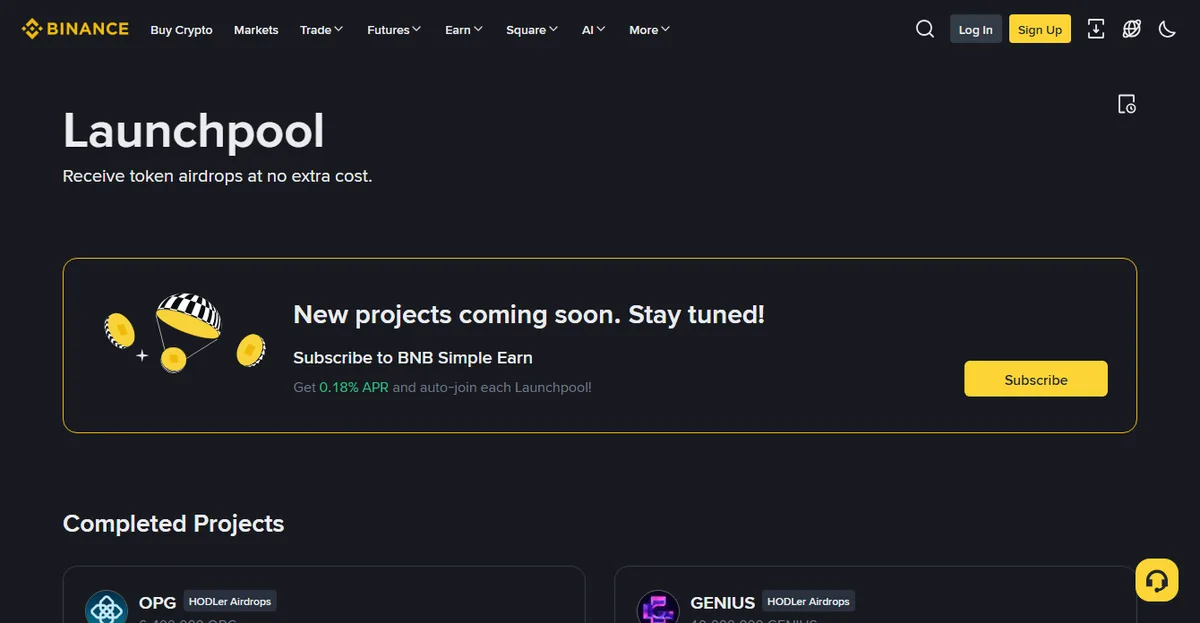
Look again at the screenshot above: the Launchpool page carries a prompt to subscribe BNB to Simple Earn and auto-join each Launchpool. That tells you something useful — parking BNB in a savings product can spare you the per-round staking step. And savings is exactly the route HODLer Airdrops use: they look at BNB held in Simple Earn (Flexible or Locked) or On-Chain Yields during a snapshot window, with no round-specific action required.
| Launchpool | HODLer Airdrops | |
|---|---|---|
| Action required | Stake into a named pool (or auto-join via savings) | None beyond holding in an eligible product |
| Calculation | Hourly share of the pool | Hourly average balance across the snapshot window |
| Timing published in advance | Yes, clear start and end | A window is given, sometimes already running when announced |
| Can one balance serve both | Depends where it sits; the eligible locations don't fully overlap — see the positioning piece | |
The snapshot side has finer rules, particularly around what doesn't count: which balances qualify and which don't.
Four things people get wrong
"300% APR — get in now"
That's an instantaneous figure computed from the current pool size and an estimated token price. The pool will grow and the price isn't established yet. Useful for comparing pools against each other; useless as an expectation.
"I'll spread across several pools to diversify"
If those pools all pay out the same new token, you've diversified your attention, not your risk — the outcome still rides on one token's price. Real diversification means different rounds and different tokens.
"I hold BNB, so I'm automatically in"
Not necessarily. BNB sitting untouched in your Spot account is neither staked in a pool nor counted in a HODLer snapshot. It has to be somewhere that qualifies.
"No rush to sell — it was free"
"It was free" is the most expensive sentence here. Newly listed tokens often move violently, and what you're holding behaves exactly like something you bought. Whether to keep it should turn on your view of the project, not on how it reached you.
Who this line suits
It suits people already holding BNB for other reasons. It suits people buying BNB specifically to farm considerably less. The reasoning is simple: the reward is incremental, but the price risk on the principal is not.
- Already holding BNB: the coins were sitting there anyway, so farming adds a layer of return on exposure you already accepted. Hard to argue against joining.
- Buying in for the round: you've added a fresh price exposure and paid to enter. A few percent against you on BNB during the round will comfortably swamp the tokens you farm. The question isn't "does this pool look good" but "do I want to hold BNB at this price".
- Very small balances: rewards are proportional, so a small stake earns a small absolute amount. A few hundred dollars of principal might return a few dollars of tokens, most of which the exit fee eats. Not a reason to skip it — just not an income stream.
My own reading is that this line is worth doing incidentally — as a layer on top of positions you hold anyway, rather than something you rearrange your holdings for. The moment you start buying assets or locking capital to chase it, the risk profile has changed and it needs a different set of sums.
Launchpool rewards = your share × time present. Two levers only: stake more, or stay longer. Anything else is optimising a variable that doesn't exist.
If you remember one thing, make it this: there is nothing here to rush for. Not the opening hour, not the pool, not the refresh button. The two decisions that move the needle — how much to commit, and what to do with the tokens afterwards — both happen outside the round, with time to think.
Rules cited here come from Binance's public help pages, checked August 2026: Launchpool help page. Minimums, eligible assets and regional restrictions can all change — go by what the page shows when you're there. If you don't have an account yet, that and verification come first: see opening an account.
Questions people ask
Does Launchpool lock up my coins?
No. The help page states you can redeem at any time. The only cost is that redeemed funds stop counting towards later hourly settlements, so your share drops from that moment on.
What is the minimum I can stake?
The published rule is 0.01 per eligible token. A low minimum is not the same as being worth it, though — stake very little and the tokens you earn may not cover the fee to sell them.
Is there any point joining several days late?
Yes, but you get less. Rewards are released hour by hour and the hours you were absent are never backfilled. The only upside of joining late is that your money was doing something else in the meantime.
Why doesn't my estimate match what I received?
Three usual reasons: the total staked in the pool kept growing while you used a single snapshot of it, balances are averaged across several samples per hour rather than taken at the moment you staked, and you redeemed part way through.
Are Launchpool and HODLer Airdrops the same thing?
No. Launchpool needs you to stake into a specific pool and settles by the hour. HODLer Airdrops look at BNB held in savings products during a snapshot window, with no per-round action needed. Binance currently presents them together on the same page.