Your first Launchpool: from announcement to tokens in the account
There are only four actions in the whole thing: read the announcement, get the funds into place, stake, wait. What actually trips people up is never those four — it's the uncertainty about what you're supposed to be doing at any given moment.
Step 0: confirm you're eligible
Do this before any announcement appears, because it can take days. Two things: verification passed, and your region not excluded.
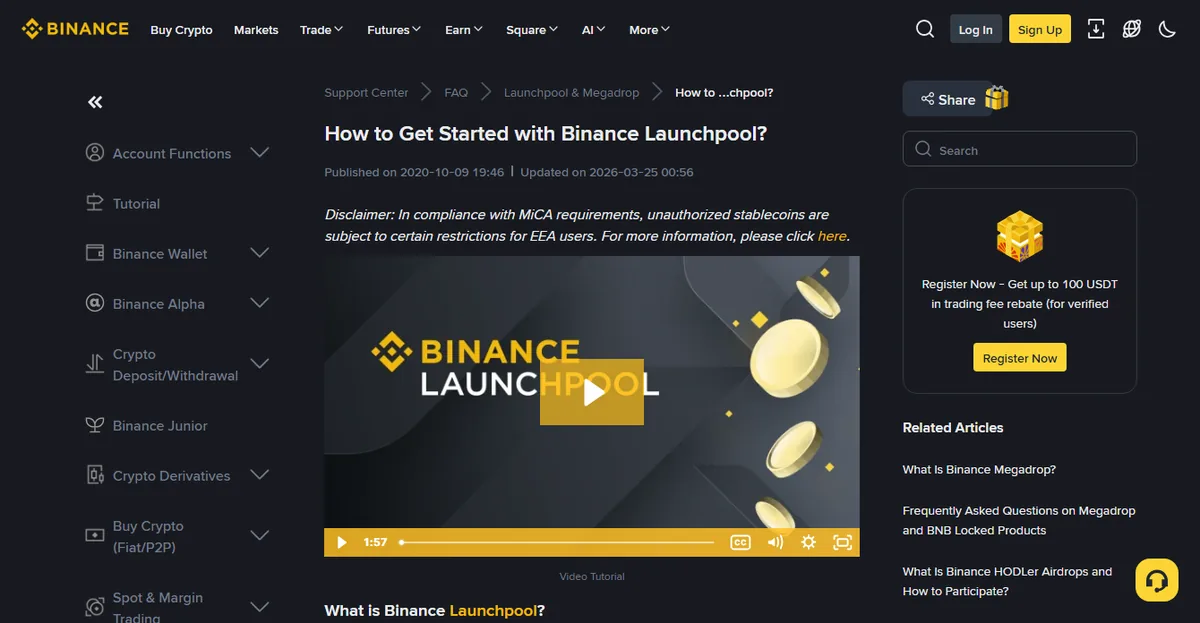
Binance's Launchpool help page states both — identity verification is required, and a list of ineligible regions is published. Reading that page once before your first round beats asking anyone.
No account yet? That and verification come first, in that order, with the usual sticking points listed in opening an account and attaching the referral code.
Step 1: read the announcement
Only four figures in an announcement drive your outcome: total rewards, duration, pool split, and this round's share of total supply. How to use them is covered in how the split works.
Three extra things to notice on a first round:
- Start time. There's usually a gap between announcement and opening. That gap is your window to get funds in place.
- Which assets are accepted. Not always only BNB. If you don't hold the other asset, don't buy it just to join.
- The restrictions paragraph. It can differ round to round; don't carry last time's conclusion over.
Step 2: get the funds somewhere stakeable
Staking draws on your available Spot balance. Money sitting in a locked product, held against an open order, or pledged as collateral cannot be staked.
So before the round opens, move what you intend to use into Spot and confirm it reads as available rather than frozen. The step most likely to bite is transferring in from outside: on-chain transfers need confirmations, and a congested network can take a while. Don't cut that fine on your first attempt.
There's a lower-effort path: subscribe BNB to Simple Earn. Binance displays a prompt on the Launchpool page saying subscribers auto-join each round. You trade a little flexibility for never having to stake manually again. Which suits you depends on your wider arrangement — see where to keep your BNB.
Step 3: stake
The entry point is the Launchpool page. While a round is live each pool has a card with an amount field and a stake button. Enter, confirm, done.
Common first-time hesitations:
- How much? There's no optimum. Most people stake everything they've allocated to it — since it's redeemable at any time, holding some back mostly just forgoes rewards.
- Should I keep a reserve? If you might need cash suddenly, sure. But given instant redemption, the case is weak.
- Splitting across pools? If they pay the same token, favour whichever has the better ratio of reward share to current stake. If they pay different tokens, that's two separate decisions.
After submitting, open the holdings view and confirm the position is there. The success toast isn't enough — my first time I closed the tab straight after confirming and only noticed the next day that I'd mistyped the amount by a decimal place.
Step 4: wait, and what not to do
Once staked, there is nothing on this line that requires action from you. Rewards accrue hourly; the page shows a running total and a live rate.
Things not to do:
- Don't watch it. Refreshing does not increase rewards.
- Don't react to a falling APR. The rate declining is what a growing pool looks like, not a signal. Unless you're exiting entirely, there's no corresponding action.
- Don't redeem and re-stake. That only loses you the hours in between.
Four numbers worth noting
The real prize from a first round isn't the tokens — it's a record that makes your next estimate accurate. Four numbers, under a minute.
- Your staked amount and when you staked it;
- The pool total when you staked;
- The pool total near the end (glance before it closes);
- What you actually received.
With those you can work out how much the round grew, how far off your estimate was, and what scale to assume next time. By your second round your expectations will be better calibrated than most people's.
I missed the third one first time and only knew I'd received less than expected without knowing why. It took another round to realise the pool had swollen in the back half — information I could have had immediately.
Step 5: after it ends
When the round closes, your principal returns to where it came from and the farmed tokens sit in your Spot account. Whether you can sell straight away depends on the listing time, which sometimes precedes the round's end and sometimes follows it.
What to do with them is a decision to make in advance rather than on the day — the three routes and their costs are in sell at listing or hold.
This is also your second reconciliation point: compare what arrived against the estimate you noted in step 4. A large gap usually means the pool grew substantially, or your participation window was shorter than you thought.
Three things that feel alarming and aren't
"Have I missed the start?"
It doesn't work that way. Launchpool isn't first-come; joining late costs you hours of accrual, not eligibility. There is nothing here to race for.
"Did I enter the right amount?"
Staking is reversible — you can redeem at any time. Get the number wrong and you redeem and redo it, losing only the minutes in between. This is unlike an on-chain transfer, where a wrong address is final.
"The APR keeps dropping — did I do something wrong?"
No. It's an instantaneous figure and a growing pool pushes it down structurally. Seeing it fall means more people joined, not that you erred. The correct response is no response.
Knowing those three in advance makes a first round much calmer. The parts that genuinely warrant care are elsewhere: entering an on-chain address, and anything you clicked that came from outside the app.
Backing out mid-round
You can redeem at any time — the help page says so explicitly. From that moment the redeemed portion stops counting; whatever you've already accrued is unaffected and stays yours.
When is exiting justified? Not often. The two reasonable cases:
- You need the money. Entirely legitimate, just redeem.
- Your view on BNB itself changed. Note that redeeming only removes it from the pool — you still hold it. Reducing exposure means selling, which is a different action.
Not a reason to exit: the displayed APR falling. As covered above, that's structural, and leaving only forfeits what remained.
For a first round, the best approach is a small amount and the full sequence. Afterwards you'll have seen the announcement, the entry point, the accrual and the close with your own eyes — and any decision about scaling up will be far better informed.
Rules cited come from Binance's public help pages, checked August 2026: Launchpool help page. Interfaces and flows change between versions — go by what you see.
Questions people ask
How soon after staking do rewards start?
From the hour you enter the pool. Balances are sampled several times per hour to produce an average, so if you join late in an hour you still get a proportion of it rather than nothing.
Can I take part for only a few days?
Yes, you can enter and exit whenever. The cost is that hours you weren't present pay nothing, so your total scales with the hours you actually stayed.
Why is the stake button greyed out?
Check three things first: whether verification reads passed rather than under review, whether your region is excluded from this round, and whether your Spot balance is actually available rather than tied up in open orders or collateral. If all three are fine, the round probably hasn't opened yet.
Will the tokens I farm be sold automatically?
No. They stay in your Spot account and it is entirely up to you whether and when to sell.