Can a Binance sub-account join Launchpool and HODLer airdrops?
Yes for sub-accounts, and Binance says so plainly. What actually costs people rewards, or the account itself, is opening a second main account. The two get confused all the time, so here they are side by side with the clause numbers.
Yes. Binance's Launchpool getting-started FAQ asks "Can sub-accounts and corporate accounts participate in Launchpool?" and answers in one word: yes. The Simple Earn Flexible FAQ goes further for BNB: sub-account BNB positions are eligible for Launchpool and HODLer Airdrops rewards.
The question that usually rides along with it is a different one entirely: what if I register a couple more accounts and take a bigger share? A sub-account is a feature that lives inside your main account. A second main account is something Binance's Terms of Use name as a reason to suspend or close an account. Below, each point is tied to the document and line it comes from.
What a sub-account is, and who can open one
A sub-account hangs off your main account; you create it, delete it and move funds into it while logged in as yourself. Binance's Sub-Account FAQ sets two conditions: identity verification completed and two-factor authentication (2FA) switched on. When we read the FAQ in October 2026, a regular user could create up to five, and VIP users got more, scaled to the main account's VIP level. Binance can change these caps; whatever the sub-account page in your own account shows is the number that counts.
In the app it lives under your profile (the icon in the top-left), inside the account information section. On the website, open the account overview and look for the sub-account tab in the side menu.
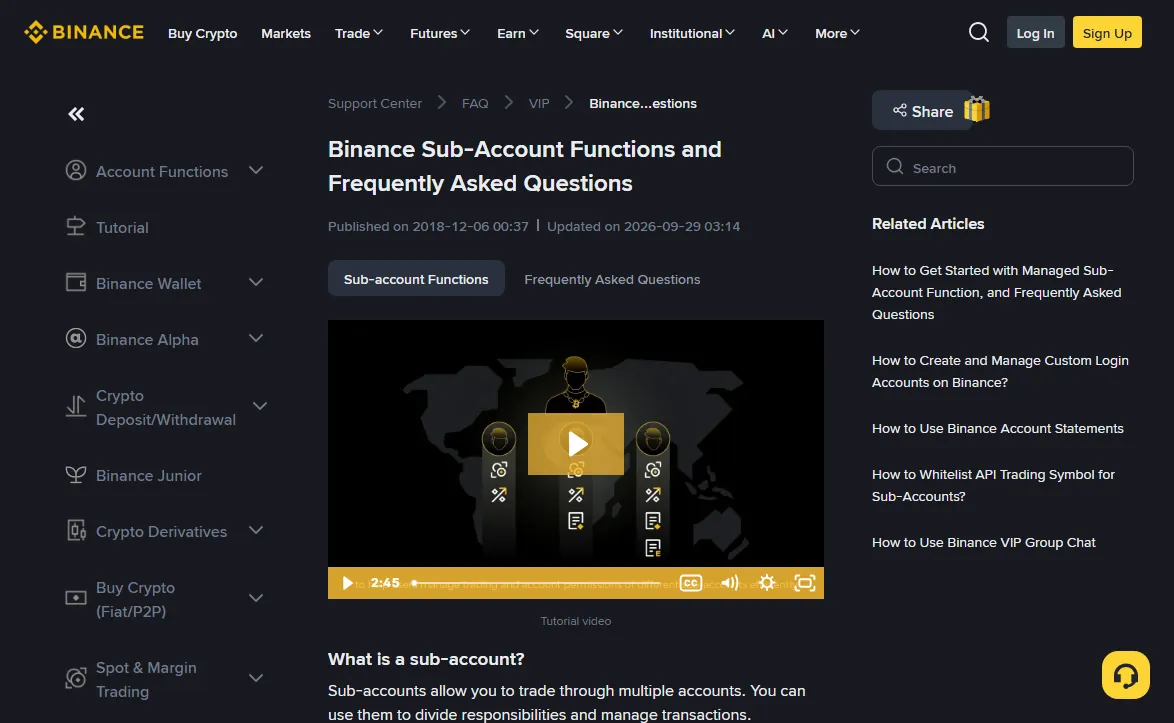
Section 7.6 of the Terms of Use adds that every natural person associated with a sub-account is subject to the identity verification requirements of section 7. A sub-account is not an unverified side door; the verified person behind it is still you.
How each of the four lines treats sub-accounts
Only two of the four lines have a written answer. For the other two there was no official wording to point to, so they stay blank rather than guessed.
| Line | What Binance wrote | Where it is written |
|---|---|---|
| Launchpool | Can sub-accounts and corporate accounts participate? Yes. | Launchpool getting-started FAQ (page marked updated 2026-10-06, checked October 2026) |
| HODLer Airdrops | Sub-account BNB positions are eligible for Launchpool and HODLer Airdrops rewards | Simple Earn Flexible FAQ, question 12 |
| Megadrop | No official wording on sub-accounts found | — |
| Alpha Points | No official wording on sub-accounts found | — |
One more data point on HODLer: the June 2024 launch announcement carries a note that it was updated on 2024-06-19 specifically to clarify sub-accounts' eligibility.
That same Simple Earn FAQ has a catch worth knowing. A sub-account earns Real-Time APR and Flexible airdrops, but not the Bonus Tiered APR, which is reserved for the main account. Moving BNB into a sub-account keeps the airdrop eligibility and changes the interest maths. Megadrop has not opened a new round in a long while; see Is another Binance Megadrop coming?. For Alpha, the rules are in How Binance Alpha Points are calculated; if you are thinking of using a sub-account there, look for the word in the campaign terms first, and if it is not there, don't assume it counts.
Caps are written per user, so splitting doesn't add up
The obvious idea: if one account is capped, spread the BNB across five sub-accounts. The source text points the other way.
The HODLer launch announcement says there is "a hard BNB holding calculation limit per user" and gives an example: a user holds 203 BNB, the limit is 200, so only 200 is used. The 4% ceiling in later announcements is likewise a single user's share of the average total. Launchpool pools carry an hourly hard cap per user too. The unit is a person, not an account.
The announcements don't spell out how main and sub-account balances are added together, and without a source we won't fill that gap. What Binance does say elsewhere is consistent with it. The terms of a June 2024 Simple Earn promotion state that each sub-account is not treated as an independent account and that its subscription amount is combined with the main account's. The Sub-Account FAQ says all sub-account trading volume rolls up into the main account, which sets the VIP tier and fee discount, and that referral rewards from sub-accounts go to the main account's referrer.
Where a sub-account genuinely helps is bookkeeping. Put the BNB you mean to keep in Simple Earn for airdrops into one sub-account and you can see at a glance whether it moved during a snapshot window. It is a ledger, not an extra ticket.
Extra main accounts: what the Terms of Use say
The opposite case is a separate account registered with another email or phone number. Three places in Binance's Terms of Use deal with it directly:
- Section 7.1: Binance may refuse any account application without giving a reason, or limit the number of Binance Accounts you may hold.
- Section 7.2(a): an individual uses the account for themselves only, not on behalf of anyone else, unless Binance has agreed in writing beforehand.
- Section 20.1(l): taking action that may circumvent Binance's controls, such as opening multiple Binance Accounts without written consent or abusing promotions, is one of the listed grounds for terminating, suspending or restricting access to an account.
Section 20.1 is about the account, not just one round's rewards. Individual Launchpool announcements then repeat the point in their own terms. The November 2024 Usual (USUAL) announcement is a typical example: Binance reserves the right to disqualify and revoke rewards for participants who engage in dishonest or abusive activities, "including but not limited to registering from the same IP or device, bulk-account registrations to farm additional bonuses".
Campaign terms decide whether this round's reward is paid, or taken back. Section 20.1 of the Terms of Use decides whether the account stays usable. Extra main accounts can trigger both.
Family members with their own accounts on one device
Say you and your partner each have a verified Binance account, share the home Wi-Fi and now and then log in on the same tablet. Where does that sit?
Two things are clear. Separate people with separate accounts is fine; the Terms limit how many accounts one person holds, not how many a household has. And operating someone else's account for them is named outright: 7.2 says the account is for your own use, and 20.1(b)(iii) lists more than one natural person accessing or trading on the same account as a ground for restriction. Placing an order for a parent, or ticking the subscription box for a spouse, falls under that line however kind the intent.
What isn't clear is how "the same IP or device" is judged. The Launchpool terms give it as an example of dishonest behaviour without publishing a threshold: how many devices, over what period. We can't see where that line is, so we won't draw one, and anyone selling a "safe multi-account setup" can't point to a source either. The plain approach holds up best: each person logs in to their own account on their own phone, and money moving between family members goes as ordinary, recorded transfers.
Already disqualified: what's left to do
First work out which situation you are in. Missing out on one round usually has nothing to do with multiple accounts; go through Nine reasons people miss an airdrop: were your BNB in an eligible product during the snapshot, is your region on the restricted list, is verification complete.
If you have been told the account itself is restricted, section 20.1 says Binance will take reasonable steps to give you appropriate notice. It doesn't promise a timeline or describe a review process for campaign eligibility. What you can do:
- Find the notice in your in-app inbox and registered email and note which reason it gives.
- Open a ticket through the official support entry in the app, with whatever shows the account is used by you alone.
- Don't close the account and start again. Section 19.1 says a frozen or restricted account may not be closable, and a fresh account is exactly the situation 20.1(l) describes.
This is also when messages offering to "unlock" accounts or "restore eligibility through an internal contact" turn up. Restoring an account goes through an official support ticket inside the app, and no step of it involves sending coins to an address to "verify" anything. The common versions of that pitch are in Fake airdrops and fake support staff.
If you haven't opened an account yet and want to see what one-person-one-account means in practice, the sign-up piece walks through registration and verification in order; if verification itself is stuck, see When verification will not go through.